Swath width is the horizontal ground distance that a sensor covers in a single pass. It’s relevant for multispectral and hyperspectral tasking collections.
When creating a tasking order, the swath width can affect the acquisition time frame. If the order AOI is wider than the sensor’s swath width, the sensor needs multiple passes to capture the AOI entirely. The more passes, the longer it takes to complete the order.
Increasing the incidence angle will improve the effective swath width, but worsen the effective ground sampling distance (GSD).
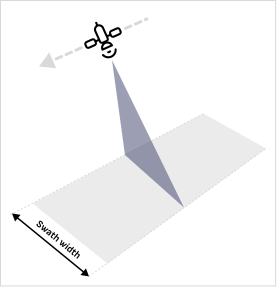
The listed swath widths are measured at nadir.
| Collection | Swath width |
|---|---|
| AxelGlobe | 55 km |
| Beijing-3A | 23.5 km |
| Beijing-3N | 11.5 km |
| Constellr | 17.5 km* |
| EROS-B | 7 km* |
| EROS-C | 12.5 km |
| GEOSAT 1 | 600 km |
| GEOSAT 2 | 12 km |
| GHGSat | 15 km* |
| GÖKTÜRK-1 | 15 km |
| Hydrosat | 70.5 km* |
| KOMPSAT-3 | 16 km |
| KOMPSAT-3A | 13 km |
| Landsat 8 | 185 km |
| Planet | SkySat: 5.9 km Pelican: 8 km |
| Pléiades | 20 km |
| Pléiades Neo | 14 km |
| Satellogic | 5 km |
| SPOT | 60 km |
| TripleSat | 23.4 km |
| Vantor | WorldView Legion: 10 km WorldView-3: 13.1 km GeoEye-1: 15.3 km WorldView-2: 16.4 km WorldView-1: 17.7 km |
*Upon request.
| Collection | Swath width |
|---|---|
| Dragonette-1 | 20 km |
| Pixxel | 40 km |